Resene Popular Paint Systems – exterior timber: training notes
This web page is an edited version of the Resene Best System Selling training notes provided to Resene staff and is provided to enable you to gain a greater understanding of the substrates and paint systems you may encounter in your decorating project. It is impossible to cover all decorating scenarios in a single document, so if you are in doubt about any aspect of your project please contact Resene for assistance.
Select the timber surface you will be painting from the list below to view how to prepare and finish the surface.
Preparation & finishing flowcharts
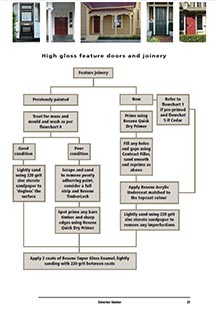
Note: Refer to the PDF flowchart for a visual of the steps below:
Treat for moss and mould and wash as per flowchart 9
Options...
Apply 2 coats of Resene Super Gloss Enamel, lightly sanding with 220 grit between coats
Prime using Resene Quick Dry Primer
Fill any holes and gaps using Contract Filler, sand smooth and reprime as above
Apply Resene Acrylic Undercoat matched to the topcoat colour
Lightly sand using 220 grit zinc sterate sandpaper to remove any imperfections
Apply 2 coats of Resene Super Gloss Enamel, lightly sanding with 220 grit between coats
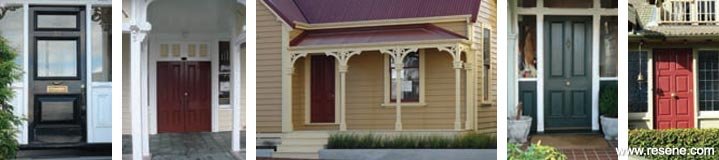
Resene Super Gloss Enamel dries to a higher gloss and has slightly better flow than Resene Enamacryl and as a result has a smoother higher gloss finish. Many people prefer this look for feature elements of their home such as a feature front door.
However Resene Super Gloss (and all solventborne paints) weathers and degrades more quickly than Resene Enamacryl, and will need to be redone sooner as a result – although as many front doors are relatively sheltered and set back from direct sunlight this can be less of an issue.
For the ‘very best gloss finish’ apply two coats of Resene Super Gloss over either Resene Quick Dry Primer or Resene Acrylic Undercoat in a colour matched to the Super Gloss colour and lightly sand with 220 grit sandpaper to achieve a smooth surface before applying the final coat.
Resene Quick Dry Primer and Resene Acrylic Undercoat have excellent sanding properties making them ideal as a base for high gloss finishes
Resene Acrylic Undercoat can be tinted to most colours in the Resene Total Colour System and is an ideal base for strong colours. However it is not suitable as a primer for bare timber as it doesn’t have the anti fungal and timber preserving properties that Resene Quick Dry Primer has.
 Get inspired ! Subscribe Get saving ! Apply for a DIY card

Can't find what you're looking for? Ask us!


Company profile | Terms | Privacy policy | Quality and environmental policy | Health and safety policy
Colours shown on this website are a representation only. Please refer to the actual paint or product sample. Resene colour charts, testpots and samples are available for ordering online. See measurements/conversions for more details on how electronic colour values are achieved.
What's new | Specifiers | Painters | DIYers | Artists | Kids | Sitemap | Home | TOP ⇧