Resene Popular Paint Systems – exterior timber: training notes
This web page is an edited version of the Resene Best System Selling training notes provided to Resene staff and is provided to enable you to gain a greater understanding of the substrates and paint systems you may encounter in your decorating project. It is impossible to cover all decorating scenarios in a single document, so if you are in doubt about any aspect of your project please contact Resene for assistance.
Select the timber surface you will be painting from the list below to view how to prepare and finish the surface.
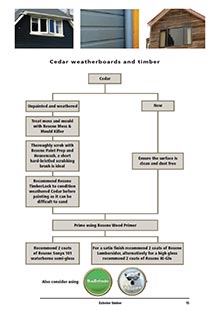
Preparation & finishing flowcharts
Note: Refer to the PDF flowchart for a visual of the steps below:
Cedar
Options...
Prime using Resene Wood Primer
Topcoat options...
Also consider using: Mouldefender and CoolColour
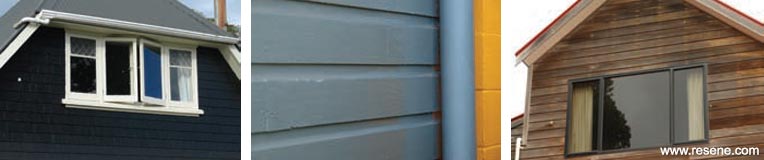
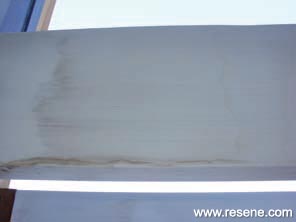
Cedar is a highly resinous timber which is also why it is so durable and able to be left to weather uncoated. However the resin will bleed through waterborne primers and paints including Resene Quick Dry (see photo). Resene Wood Primer is our only recommendation.
Resene Waterborne Woodsman is not affected by the resin bleed and can be applied directly onto Cedar. Conditioning with Resene TimberLock, while a good idea before priming will not prevent the stain from leaching through Resene Quick Dry Primer.
However, surface forming wood stains should be avoided however as the top layer of Cedar degrades quickly under U.V. attack resulting in the stain flaking off. Refer to Resene Help line if asked for a paint system to redo flaking stains on Cedar.
Redwood is part of the same family as Cedar and while it is much less common for new or recently constructed homes it presents the same issues when painted.
Cedar is a comparatively soft timber (more so than pine) and is easily damaged by waterblasting. Our only recommendation is to scrub or wash with Resene Paint Prep and Housewash.
Aged grey Cedar can be painted but should first be conditioned with Resene TimberLock before priming and painting. Typically Cedar weatherboards are not smooth sawn and are difficult to sand and prepare. Resene TimberLock should be viewed as an alternative to sanding where the surface or texture of the timber makes it impractical.
Flathead nails (including copper nails) are often used and left exposed rather than punched and filled and are simply primed and painted at the same time as the weatherboards.
Cedar is easily painted and is an excellent substrate for paint (more so than pine for example) once painted repainting is straightforward the only real consideration is that any bare areas need to be spot primed with Resene Wood Primer rather than Resene Quick Dry.
Resene Sonyx 101 or Resene Lumbersider suit Cedar more so than the high gloss Resene Hi- Glo due to the surface texture of the timber particularly quarter sawn boards. If repainting refer to flowcharts 2 and 3 and prime or spot prime with Resene Wood Primer.
 Get inspired ! Subscribe Get saving ! Apply for a DIY card

Can't find what you're looking for? Ask us!


Company profile | Terms | Privacy policy | Quality and environmental policy | Health and safety policy
Colours shown on this website are a representation only. Please refer to the actual paint or product sample. Resene colour charts, testpots and samples are available for ordering online. See measurements/conversions for more details on how electronic colour values are achieved.
What's new | Specifiers | Painters | DIYers | Artists | Kids | Sitemap | Home | TOP ⇧